Skills and traits
A survivor gets better by doing. A swing trains the weapon's skill and sprinting trains Athletics. Books speed learning up, and the occupation and traits chosen at creation decide where the character starts.
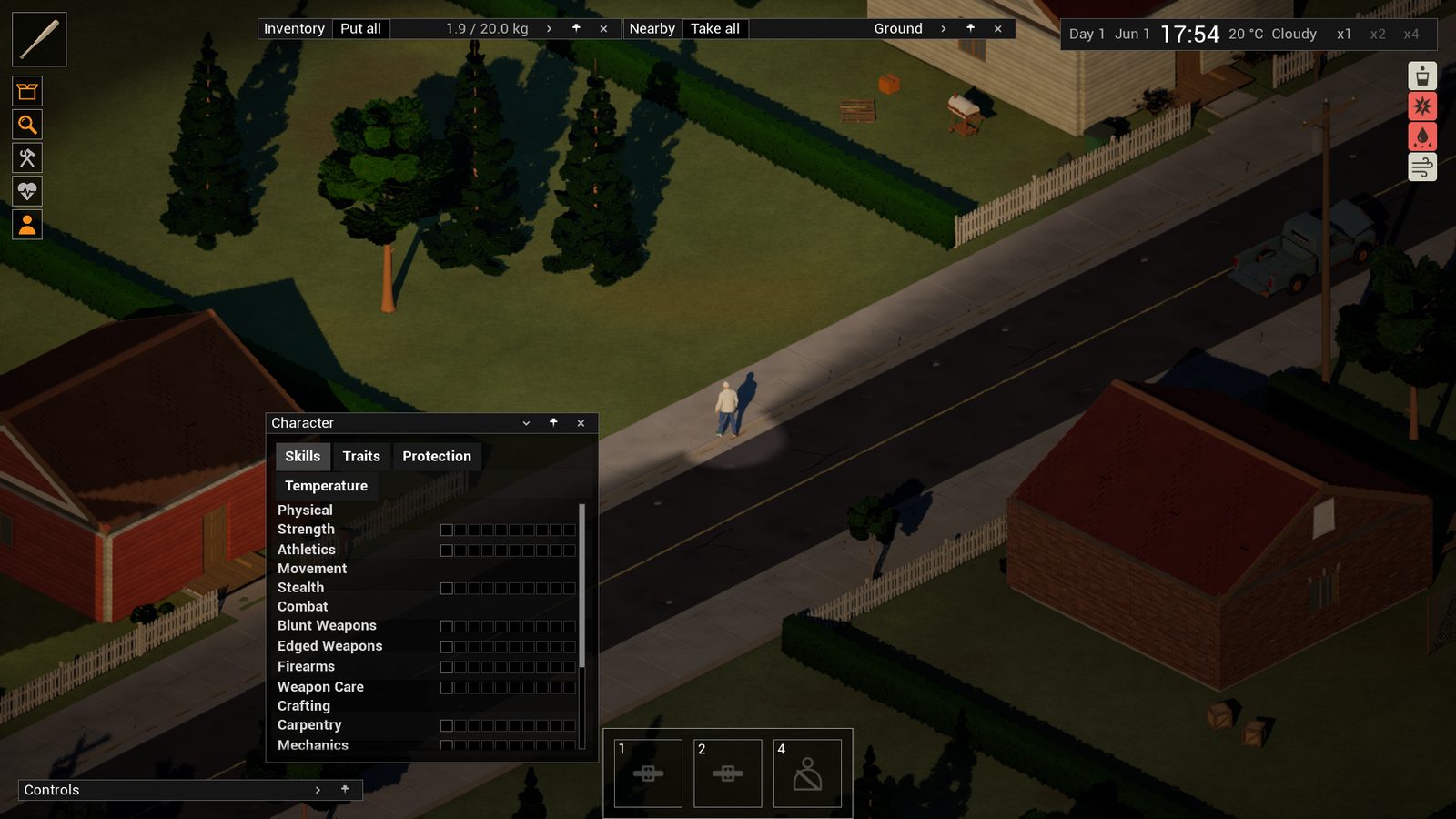
In the game
Skills
A survivor has fourteen skills in five families, each with a level from 0 to 10. The character window lists them in this order:
| Family | Skills |
|---|---|
| Physical | Strength, Athletics |
| Movement | Stealth |
| Combat | Blunt Weapons, Edged Weapons, Firearms, Weapon Care |
| Crafting | Carpentry, Mechanics, Electrical, Tailoring |
| Survival | Medicine, Cooking, Outdoors |
A level is reached at the next threshold of the skill's curve: 75, 150, 300, 750, 1500, 3000, 4500, 6000, 7500 and 9000 points. Extra experience carries over, a message tells you, and experience stops at level 10.
What a higher level does
From level 0 to level 10:
| Skill | What a higher level does |
|---|---|
| Strength | up to 10 kg more carried, knockback up to x1.5 |
| Athletics | sprint speed up to x1.2, climbing over a fence or a window up to 40 % shorter |
| Stealth | footsteps up to 60 % quieter for the zombies |
| Blunt Weapons, Edged Weapons | melee damage up to x1.5, up to +15 % critical chance, swings up to x1.3 faster, only with a weapon of that skill in hand |
| Firearms | spread halved, reloads up to 40 % shorter, only with a firearm in hand |
| Weapon Care | the weapon in hand, and the tools you use, wear up to 70 % less often; a repair gives back up to twice as much |
| Carpentry | building, barricading and dismantling up to twice as fast; wooden pieces up to twice as solid; dismantling wood fails 30 % of the time at level 0 and never at level 10, and gives back x0.6 to x1.4 |
| Mechanics | welding up to twice as fast; metal pieces up to twice as solid; dismantling metal fails 30 % of the time at level 0 and never at level 10, and gives back x0.6 to x1.4 |
| Medicine | treatments given up to twice as good: the wound heals faster and a bandage stops a bleed more surely |
| Tailoring | ripping gives one more piece of fabric every four levels; a pad adds its fabric's padding x0.5 at level 0, up to x1 at level 10; a patch you unpick gives its piece back 10 % of the time at level 0, 60 % at level 10 |
The other three skills are read where they are used. Hotwiring a car needs Electrical 1 and connecting a generator Electrical 3. A meal from the cooking pot is worth more with Cooking, and fishing and foraging chances grow with Outdoors.
A weapon trains and reads the skill its definition names. A weapon without one, like bare fists, reads no weapon skill.
Learning by doing
| Source | Points |
|---|---|
| sprinting | 1 Athletics every 5 s |
| climbing | 3 Athletics |
| moving under a heavy load (over 75 % of what you can carry) | 1 Strength every 10 s |
| a swing with a weapon of 1.5 kg or more | 1 Strength |
| barricading or dismantling | 2 Strength, on top of their Carpentry |
| a hit on a standing zombie | 2 of the weapon's skill (nothing for a zombie already down or dead) |
| a shot that hits | 3 Firearms |
| wear taken by your weapon | 2 Weapon Care |
| walking quietly near zombies that are not after you | 1 Stealth every 5 s |
| a treatment given | 5 Medicine |
| a piece of clothing ripped | 1 Tailoring |
| a patch or a pad sewn | 3 Tailoring |
| cooking a food | 10 Cooking |
| a cast of the fishing rod | 5 Outdoors |
| picking at a forage spot | 5 Outdoors |
The same gesture on the same target cannot be repeated for experience. Crafting, building, welding a barricade, repairing, upgrading and dismantling grant the points their recipe, piece, barricade, restoration or action names.
A book you have read for the skill, and a skill your occupation starts higher, both raise what a gesture earns. Your traits and the Experience game option scale it too.
The exact formula
A grant is multiplied by the book multiplier, by the boost of a skill your occupation starts higher (x1.5, x1.75, x2 for starting levels 1, 2, 3), by the experience stats of your traits and by the Experience game option. One grant is capped at 500 points.
Books
Seventy skill books lie in the bookshelves of Pine Hollow, five volumes for each of the fourteen skills. Each volume is written for a band of levels, from volume 1 for levels 0 and 1 to volume 5 for levels 8 and 9.
Use a book from your bag to read it. Reading takes 60 to 180 game minutes depending on the volume, less with a reading trait. It stops if you move or are hit, and keeps what you have read. It needs daylight, a lit flashlight or torch, or a lit lamp post within 6 m. Without one you get "Too dark to read.".
At 25, 50, 75 and 100 % read, the book raises a multiplier on the experience of its skill: x1.5, x2, x2.5, x3 for volume 1, up to x2.5, x4, x5.5, x7 for volume 5. It applies while your level is inside the book's band, and the character window shows it ("x2"). Past 100 %, a book has nothing more to give.
The book's row in the bag has a reading bar on its icon, and its tooltip gives the skill, the levels and how much is read. Progress is kept per reader. The others see you reading, never your progress. Magazines are books that teach recipes instead.
Occupations and traits
You pick an occupation and traits at character creation. An occupation gives starting levels and points to spend on traits. Twelve ship:
| Occupation | Points and starting skills |
|---|---|
| Drifter (the default) | 8 points, no starting skill |
| Handyman | 0 points, Carpentry 2, Mechanics 1 |
| Paramedic | 0 points, Medicine 3, Athletics 1 |
| Courier | 2 points, Athletics 2, Stealth 1 |
| Bouncer | 0 points, Blunt Weapons 2, Strength 2 |
| Gunsmith | 0 points, Firearms 2, Weapon Care 2 |
| Butcher | 2 points, Edged Weapons 2, Cooking 1 |
| Mover | 2 points, Strength 3 |
| Librarian | 4 points, grants Speed Reader |
| Lineworker | 0 points, Electrical 3, Athletics 1 |
| Auto Shop Hand | 0 points, Mechanics 3, Weapon Care 1 |
| Hunting Guide | 0 points, Outdoors 2, Firearms 1, Stealth 1 |
Forty-two traits ship: twenty-four that cost points and eighteen that give some back. Each one changes stats such as carry weight or reading speed. Five give starting levels (Powerful Build, Track Athlete, Field Medic, Woodworker, Range Regular), added to the occupation's and capped at 10. Traits that contradict each other exclude each other (Quick Study and Slow Study, Speed Reader and Never Learned to Read, and others).
Eight traits read the systems of health, clothing and sleep. A positive cost takes points, a negative one gives them back:
| Trait | Cost | Effect |
|---|---|---|
| Short Sleeper | 3 | "Needs 20% less sleep." (Stat.Sleep.Duration x0.8) |
| Long Sleeper | -3 | "Needs 20% more sleep." (x1.2) |
| Hardy | 4 | "Sickness takes hold 30% more slowly." (Stat.Sickness.Rate x0.7) |
| Sickly | -4 | "Sickness takes hold 40% faster." (x1.4) |
| Tough Hide | 4 | "One hit in five that gets past the clothes leaves no wound." (Stat.Wound.ThroughChance +0.2) |
| Steady Nerves | 4 | "Panics half as fast." (Stat.Panic.Rate x0.5) |
| Jumpy | -4 | "Panics 60% faster." (x1.6) |
| Weathered | 4 | "Feels heat and cold 40% less." (Stat.Temperature.Exposure x0.6) |
Short Sleeper and Long Sleeper exclude each other, and so do Hardy and Sickly, and Steady Nerves and Jumpy.
The host checks a new character on arrival: known occupation and traits, no excluded pair, points not overspent. It turns an invalid one away with the reason.
The character window
Press P. The window has four tabs: Skills, by family, with experience bars, the book multiplier and a tooltip per skill; Traits, the occupation first, then each trait with its description; Protection; and Temperature, which Clothing and temperature describes.
Levels, experience, books read, the occupation and the traits are kept in the character sheet of the host's save. In co-op each player sees only their own levels.
Stat modifiers
Skills, statuses, wounds, the clothes worn, sleep, the firearm in hand with its attachments, traits
and the occupation all act on the game through stat modifiers. A modifier names a stat and adds to
it or multiplies it. Additions are applied to the base first, then multiplications. A modifier on a
parent stat covers its children: Stat.ActionDuration covers Stat.ActionDuration.Manual.
A system of your own reads a stat with
Blueprints/Core/BFL_ZSStats.GetModifiedValue(Actor, Stat, Base), and a component of your own
becomes a source by implementing BPI_StatModifierSource.
The game reads these stats:
- action durations (
Stat.ActionDuration.*), reading speed and experience gain (Stat.XPGainand one per family); - carry weight, sprint speed, walking speed (
Stat.Move.Speed) and footstep noise; - melee damage, critical chance, swing speed and knockback, firearm spread and weapon wear;
- treatment quality and healing;
- the three need rates (
Stat.Needs.*), and endurance recovery and cost (Stat.Endurance.Regen,Stat.Endurance.Cost); - the rates of panic and sickness (
Stat.Panic.Rate,Stat.Sickness.Rate) and the length of sleep (Stat.Sleep.Duration); - the chance that a wound past the clothes is spared (
Stat.Wound.ThroughChance) and exposure to heat and cold (Stat.Temperature.Exposure).
The assets
Skills (PDA_SkillDef), occupations (PDA_OccupationDef) and traits (PDA_TraitDef) are Data
Assets in Content/ZombieSurvival/DataAssets/Progression/Childs/, next to
DA_SkillEffects_Default and DA_ProgressionSettings_Default. A book is an item,
DA_Item_Book_<Skill>_<N> (category Literature, 0.5 kg), whose BookDef points at its
DA_Book_<Skill>_<N>, a PDA_BookDef.
| Asset | Property | Default | What it does |
|---|---|---|---|
DA_Skill_* |
XPToNextLevel |
75, 150, 300, 750, 1500, 3000, 4500, 6000, 7500, 9000 | one threshold per level; its length is the top level |
DA_Skill_* |
XPBoostByStartLevel |
x1.5, x1.75, x2 | the learning boost of a skill the occupation starts higher |
DA_Skill_* |
PendingEffectNote |
the tooltip note of a skill nothing reads | |
DA_SkillEffects_Default |
Effects |
see What a higher level does | one row per skill and stat, eleven values for levels 0 to 10 |
DA_SkillEffects_Default |
XPSources |
see Learning by doing | one row per way of learning: points, guard, interval |
DA_SkillEffects_Default |
grant cap, heavy load, heavy weapon | 500, 75 %, 1.5 kg | the limits of learning by doing |
DA_SkillEffects_Default |
quiet walking radius, training tick | 800 uu, 1 s | the radius of quiet walking near zombies, and the tick of continuous sources |
DA_Action_FoodCook, DA_Action_FishCast, DA_Action_ForagePick |
XPAmount |
10 Cooking, 5 Outdoors, 5 Outdoors | the points of cooking a food, of a cast of the fishing rod and of picking at a forage spot |
DA_Occupation_* |
points, starting skills, granted traits, GrantedRecipes, GrantedPieces |
see Occupations and traits | an occupation |
DA_Trait_* |
cost, exclusions, modifiers, StartingSkills, GrantedRecipes, GrantedPieces |
per trait | a trait |
DA_Book_<Skill>_<N> |
skill, volume, band, minutes, milestones | 60 to 180 game minutes | a skill book |
DataAssets/Progression/Childs/DA_ProgressionSettings_Default |
skills, occupations, traits, books, families | Drifter by default | what a character can have |
Every number of What a higher level does except Tailoring's is a row of Effects. The sewing
gestures read the Tailoring level themselves, and so do the systems that use Electrical, Cooking
and Outdoors.
Change it
- To change a skill's curve, what a level does or what a gesture earns, edit
XPToNextLevel,EffectsorXPSources. The Experience game option scales experience for a whole world. - To change the skill a weapon trains and reads, set its
SkillTag. - To add a skill, a trait or an occupation, give its Data Asset a tag under
Skill.,Trait.orOccupation.and add it to its array inDA_ProgressionSettings_Default. A new occupation or trait shows on the character creation screen at once. - To add a book, create its
DA_Book_<Skill>_<N>and its item, register the item, list the book inBooksand add the item to a loot table (on a small map of your own, to a container of the spawn plan).
Tune the systems gives the steps for both.
A fifteenth skill, DA_Skill_Farming, ships with its five books but is not listed, because no
system of this release uses it. To bring it back, add it to Skills in
DA_ProgressionSettings_Default and move its books from ExcludedItems of
DA_LootSettings_Default to DA_LootTable_Books. The save keeps skills by their tag, so nothing
shifts.