Crafting
Crafting turns what the survivor finds into something better, such as logs into planks or scrap metal into bars. Every recipe takes time, uses the tools in the bag and can ask for a skill level or a workbench.
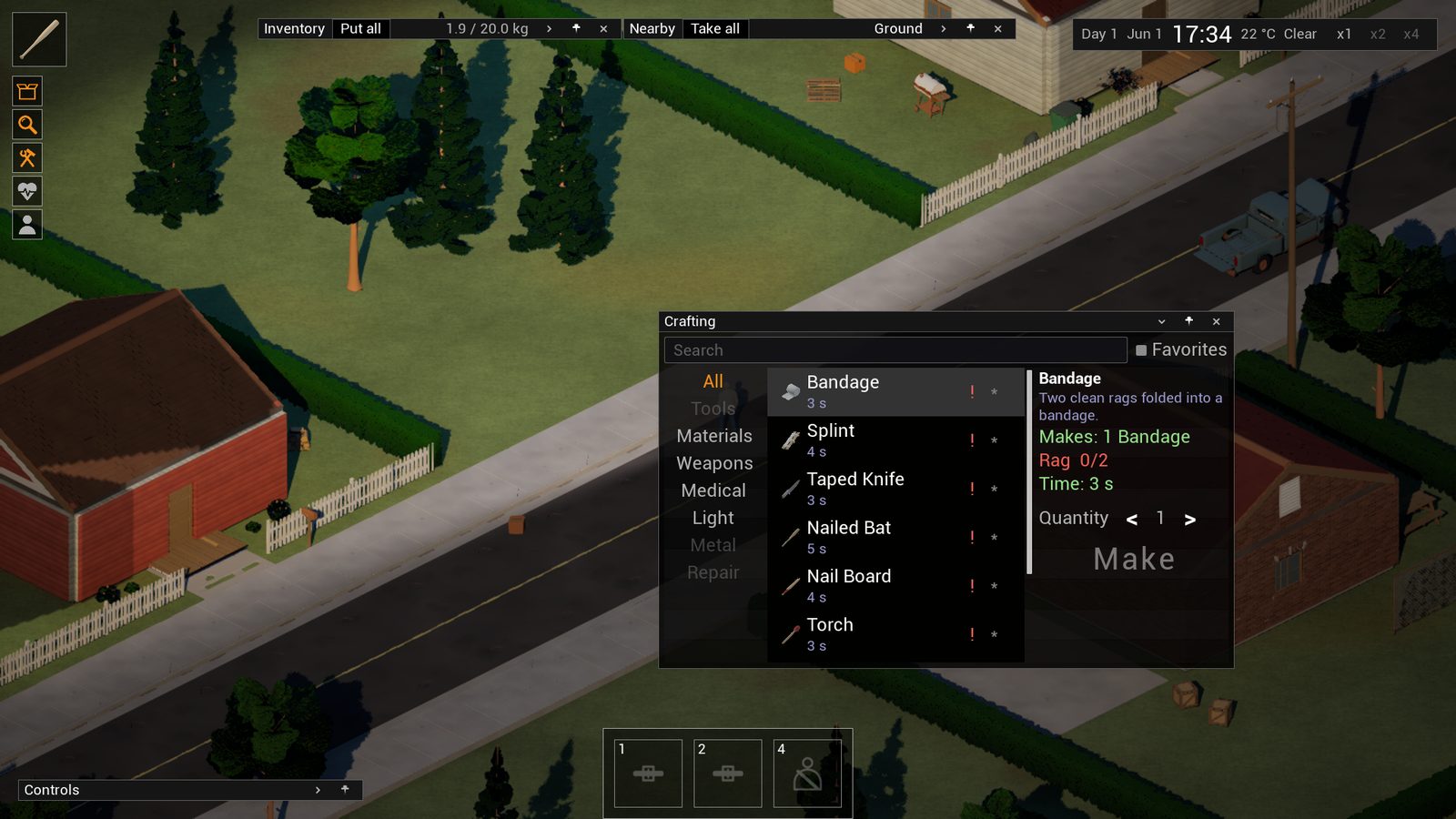
In the game
The crafting window
Press C. The categories are on the left: All, then Materials, Tools, Weapons, Medical, Light and Metal, then Repair. A category where you know nothing is greyed.
The middle column lists the recipes you know in that category, with a search box and a Favorites filter. A row shows the result's icon, its name, the time it would take you, a red "!" when it cannot be made right now, and a star.
The right column details the recipe: what it makes, each ingredient as have/required in green or red with where it is ("Bag", the container's name, "Ground"), each tool with its condition or charge, the skill, whether the workbench is in reach, and the time. Set a quantity with the arrows, capped by what the bag and the sources allow, and press Make. When Make is greyed, its tooltip gives the reason.
The window keeps itself up to date, so walking up to a crate updates it. Every button takes the focus on a gamepad. The recipes you star are kept in the player's local profile and do not follow a player to another PC.
The Repair category mends weapons and tools and refills the blowtorch.
What a recipe takes
A recipe is a timed action. Those that ship take 3 to 12 seconds and grant 2 to 8 points to their skill. A recipe uses up its ingredients. Its tools must be in the bag: they are not used up, but they wear, and a blowtorch spends charge. It may ask for a skill level and a workbench. It makes a noise when it ends, and hammering carries further than welding or sawing.
The timed action of a recipe sets what speeds it up. The woodworking action is up to twice as fast at level 10 of Carpentry, the welding action at level 10 of Mechanics, and the plain one takes the same time for everyone, before traits.
Where the ingredients come from
Ingredients come from the bag first, then from the containers and the items on the floor inside the interaction radius, nearest first. Nothing is taken through a wall, so a crate on the other side of a thin wall does not count.
The ingredients are used up only when the craft ends, and they must still be within reach then. If two players craft from the last rags of one crate, one gets the bandage and the other gets a refusal.
The result goes into the bag, or lands at your feet when the bag refuses it ("Placed on the ground: Bandage").
A request is checked in this order, and the first failure is the message you see:
- "Unknown recipe"
- "Too many at once"
- "Skill too low"
- "Workbench needed"
- "Missing components or tool"
Workbenches
One workbench ships, the "Carpentry Workbench", and the four metal recipes need it. Any piece of furniture set up as that station counts as the bench, if it is within 200 uu and in a clear line. If you walk away from it while the action runs, nothing is consumed and you get "Workbench needed". Players can build their own workbench.
Batches
Ask for three bandages and the queue shows one entry, "×3". The crafts follow each other without a new request, and each one grants its own experience. Cancelling stops the batch. Running out of an ingredient or a tool stops it too and tells you why. The batch does not wait for you to fetch more. The largest batch is 20.
Learning recipes
The crafting and build windows list only what your character knows, and the host refuses the rest ("Unknown recipe", "Unknown piece"). A recipe, like a buildable piece, is in one of three states:
- known from the start;
- opened by a skill level, as the improvised hammer is at Carpentry 1. A level that opens something says so ("New recipes: …");
- learned, and kept in the character sheet.
Occupations and traits teach some on arrival. The Handyman knows the plank shelf and the plank bed, the Auto Shop Hand the metal bar and sheet metal recipes and the metal fence, and the Field Medic trait the stick splint.
Four magazines teach the rest. A magazine reads in 30 game minutes, under the same light rule as any book. When it is finished, its reader knows its contents and is told, for example "Learned: Stick Splint, Improvised Hammer.". A finished magazine cannot be read again.
| Magazine | Teaches |
|---|---|
| Shop Floor Basics | the metal bar, the sheet metal, the metal fence |
| Weld It Right | the crowbar, the sledgehammer, the metal wall |
| Furniture From Scrap Wood | the plank shelf, the plank bed, the water collector |
| Field Fixes | the stick splint, the improvised hammer |
They are found with the books, with the hardware and at the gas station. No magazine teaches the metal bars barricade, because Mechanics 2 is enough.
The recipes that ship
Fifteen recipes ship. Six make supplies and weapons: the bandage, the splint, the taped knife, the nailed bat, the nail board and the torch. The other nine turn materials into other materials and tools:
| Recipe | Asset | Uses | Tools | Makes | Skill and bench | Known |
|---|---|---|---|---|---|---|
| Planks from a Log | DA_Recipe_SawLog |
1 log | saw | 3 planks | Carpentry 0 | from the start |
| Wooden Sticks | DA_Recipe_SawPlank |
1 plank | saw | 2 wooden sticks | Carpentry 0 | from the start |
| Pull Nails | DA_Recipe_PullNails |
1 nail board | hammer | 1 plank, 2 nails | Carpentry 0 | from the start |
| Stick Splint | DA_Recipe_StickSplint |
2 wooden sticks, 1 rag | 1 splint | Field Fixes | ||
| Improvised Hammer | DA_Recipe_ImprovisedHammer |
1 wooden stick, 1 scrap metal, 1 duct tape | 1 hammer | Carpentry 1 | at Carpentry 1, or Field Fixes | |
| Metal Bar | DA_Recipe_MetalBar |
3 scrap metal | blowtorch (5 charge), welding mask | 1 metal bar | Mechanics 1, workbench | Shop Floor Basics |
| Sheet Metal | DA_Recipe_SheetMetal |
4 scrap metal | blowtorch (10), welding mask | 1 sheet metal | Mechanics 2, workbench | Shop Floor Basics |
| Crowbar | DA_Recipe_Crowbar |
2 metal bars | blowtorch (10), welding mask | 1 crowbar | Mechanics 3, workbench | Weld It Right |
| Sledgehammer | DA_Recipe_Sledgehammer |
2 metal bars, 1 wooden stick | blowtorch (10), welding mask | 1 sledgehammer | Mechanics 4, workbench | Weld It Right |
Thirteen items come with crafting and building:
- materials: the log, the wooden stick, screws, glue, scrap metal, sheet metal, the metal bar and the propane tank;
- tools: the saw (condition 20), the screwdriver (25), the blowtorch (charge 100) and the welding mask;
- the sledgehammer, a heavy blunt weapon (80 damage, condition 30) that is also the demolition tool.
The hammer has a condition of 25. On Pine Hollow all thirteen are in the hardware loot table,
DA_LootTable_Hardware, and DA_LootTable_Crates also draws logs, scrap metal and propane tanks.
The assets
A recipe is a PDA_RecipeDef in Content/ZombieSurvival/DataAssets/Recipes/Childs/, listed in
DA_RecipeBook_Default. A workbench is a PDA_WorkstationDef, in the same folder. A magazine is a
book with no skill: a PDA_BookDef with TeachesRecipes and TeachesPieces.
| Asset | Property | Default | What it does |
|---|---|---|---|
DataAssets/Recipes/Childs/DA_CraftingSettings_Default |
MaxBatch |
20 | the largest batch |
DA_CraftingSettings_Default |
SourceTolerance |
80 uu | the margin the host adds to the reach of the sources |
DA_CraftingSettings_Default |
Restores |
duct tape, glue, propane tank | the restorations the Repair category offers |
DA_Workstation_Carpentry |
Range |
200 uu | how close the bench must be |
DA_Recipe_* |
BaseDuration |
3 to 12 s | the time before skill and traits |
DA_Recipe_* |
ActionDef |
DA_Action_Craft, DA_Action_CraftWood or DA_Action_Weld |
the timed action that runs the recipe: plain (no skill), woodworking (Carpentry) or welding (Mechanics) |
DA_Recipe_* |
XP |
2 to 8 points | the experience each craft grants |
DA_Recipe_* |
NoiseTag |
per recipe | the row of the noise table played when the craft ends; empty is silent |
DA_Recipe_ImprovisedHammer |
LearnAtLevel |
1 | opens the recipe at Carpentry 1 |
DataAssets/Noise/Childs/DA_NoiseSettings_Default |
hammering, sawing, welding rows | 0.9, 0.6, 0.7 | how far zombies hear the craft |
DataAssets/Loot/Childs/DA_LootTable_Books, DA_LootTable_Hardware, DA_LootTable_GasStation |
Entries |
the four magazines | where the magazines are found |
Blueprints/UI/WBP_CraftWindow |
RefreshSeconds |
0.35 s | how often the open window updates |
Change it
- To tune a recipe, open its
DA_Recipe_*and changeInputs,Outputs,Tools,ActionDef,BaseDuration,SkillTag,MinLevel,Workstation,XPorNoiseTag. - To add a recipe, a category or a workbench, follow Add a recipe. A
piece of furniture is a bench when its
Workstationnames the station. - To change who knows a recipe, tick
bKnownByDefault, setLearnAtLevel, or list it in theTeachesRecipesof a magazine or in theGrantedRecipesof an occupation or a trait. A buildable piece is taught the same way, throughTeachesPiecesandGrantedPieces.