The large map
Pine Hollow, Content/ZombieSurvival/Maps/L_World, is a World Partition map of 512 × 512 m in cells
of 64 m. On top of the survival systems it runs world systems of its own, such as loot tables,
locked houses, fire and hordes. The host decides all of them and saves them with the world.
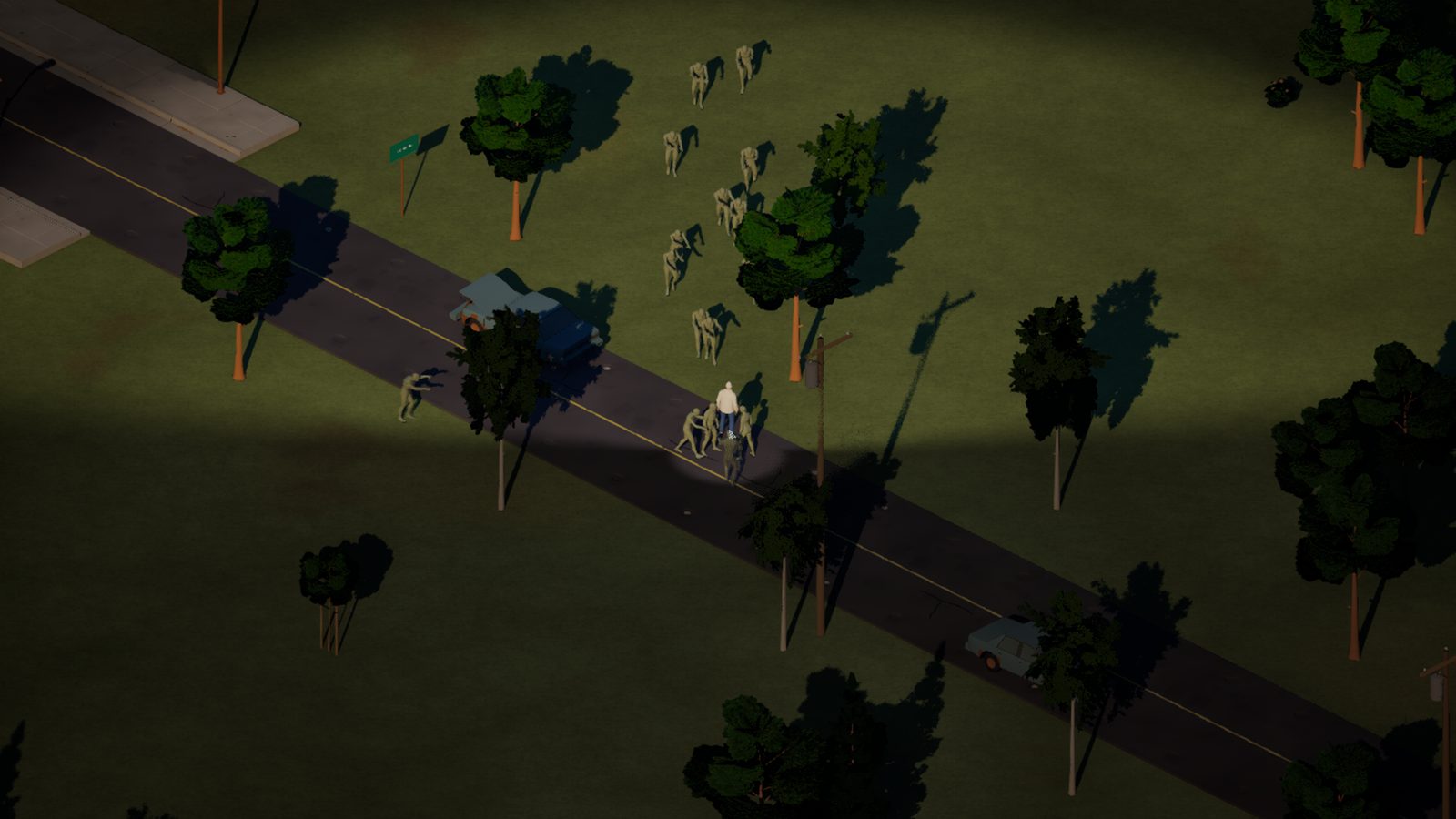
In the game
Loot
A container placed in the map is filled once per world, the first time it loads, and an emptied one stays empty. The host looks at the room the container stands in and at the furniture it is, then takes:
- the loot table that names both;
- otherwise the one that names the room only;
- otherwise the one that names the furniture only.
With none, the container stays empty. A container filled by hand keeps its contents.
Three game options make finds rarer or more common, each from 0 to 2: one for food and drink, one for weapons and ammunition, one for the rest.
The exact formula
A table rolls RollsMin to RollsMax times. Each entry weighs its Weight times the game
option of its category: Sandbox.World.FoodLoot, WeaponLoot or OtherLoot, from 0 to 2.
Houses
The first time a house loads, the host draws whether it is locked (40 %) and whether it is alarmed (15 %).
- A locked house has its outside doors locked and its key in one of its own containers.
- An alarmed house rings for 180 s when a window is broken or a door forced while it has power. While it rings, the siren is a loud noise for the zombies.
The siren ships silent. The zombies hear the alarm either way.
Power and water
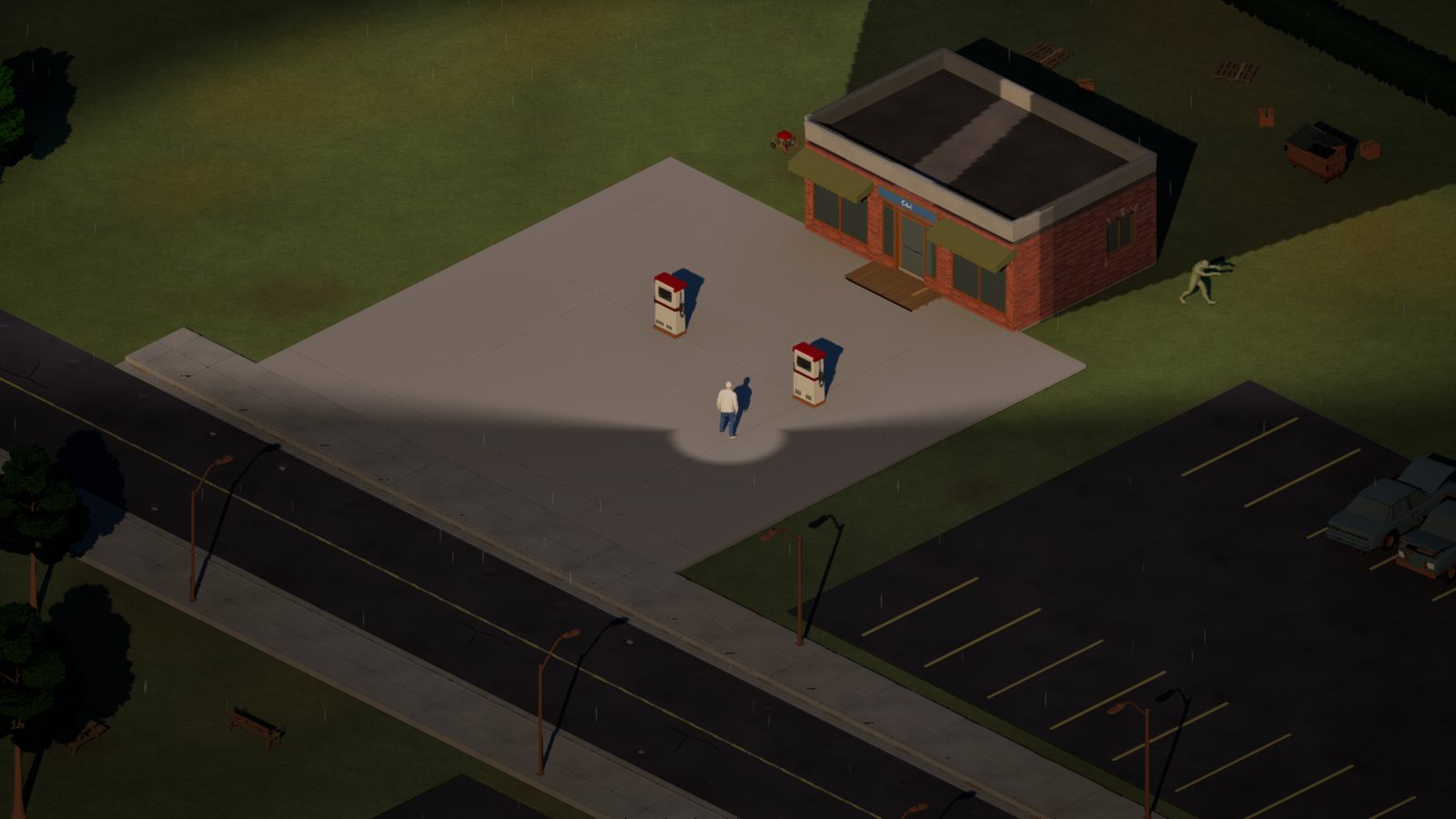
The grid and the water each go off on a day drawn once per world, no later than the day the game options give. An option turned off means never. Without power, the fuel pumps stop and the street lights and the room lights go dark.
Generators
A generator is a piece of furniture you carry (15 kg) and set down. Connect it, which takes 4 s and Electrical 3 or the Generator Basics magazine, fill it from a jerry can and switch it on. It powers everything within 20 m on its own floor. Its 10 l tank lasts 24 h idle and 8 h at full load. While it runs it makes noise for the zombies and cannot be lifted.
Three generators stand empty in Pine Hollow. They run on petrol and never wear out.
Fire
A fire spreads from one 1.5 m cell to the next, over 200 cells at most at a time, by what the surfaces are made of. Wood, grass and fabric burn. Concrete, stone, metal and water do not.
A burning cell hurts the zombies in it, gives survivors a burn, burns away built pieces and furniture, empties containers and consumes corpses. It shows flames and smoke and casts no light of its own. The three nearest cells are heard. A fire far from every player waits for someone to come back.
- Put out fire (2 s) uses an extinguisher (10 charges, 2.5 m) or a water bottle (0.8 m).
- Burn corpse (3 s), with a lighter or matches and a jerry can (1 l), sets a corpse within 2 m on fire.
Felling trees
Strike a forest tree with the axe, a two-handed weapon. After 6 strokes it falls, leaving a stump and 3 logs. Felled trees stay felled in the save.
World events
Once per world, between day 5 and day 10, a helicopter crosses the map over a survivor in four minutes, and its noise draws the zombies below it. Up to two distant noises a day, gunfire or a scream, also sound 60 to 90 m from a survivor, and zombies walk towards them. A game option scales how often.
The three events ship silent, but they still happen and still draw the zombies.
Zombies
On a partitioned map, the zombies are sown by population volumes, boxes placed in the map. When a new world starts, each volume sows zombies in proportion to its area, its density and the zombie multiplier of the game options, away from its houses and from the start points. Each zombie's archetype is drawn on the volume's weights.
The exact formula
On the first tick of a new world, each volume draws
round(hectares × DensityPerHectare × ZombieMultiplier) points. Each point becomes a zombie.
Pine Hollow has four volumes and 301 zombies at the default multiplier: the centre at 40 per hectare, the south and north districts at 36, the forest at 19. A zombie of the districts carries nothing.
Zones and hordes
The map is cut into zones of 64 m. A zone further than 112 m from every survivor is packed into the world save with everything in it. It comes back when a survivor is within 104 m.
Only the zombies around the players exist in full. Further away, a packed zone that holds at least 4 zombies groups them into hordes of up to 20, which the host keeps as data.
- A horde drifts around its home.
- It walks towards a loud noise, which it hears from further away the louder it is, 180 m for a shotgun.
- When its leader enters a zone that comes back, it turns into full zombies again, no more than 120 for the hordes.
The world map
Press M on Pine Hollow to open the whole map, on light paper, under a fog that lifts 40 m around your survivor as you walk. Your survivor is a red marker. Your co-op partners are blue markers, shown only where you have explored.
There are six kinds of mark: a left click places one, a right click removes it, and the mouse wheel changes the kind. Each player has their own map and marks, saved with the world and given back when they return. A mini-map, top right, is off by default.
The map has no zoom and no scrolling. Found maps and shared marks are not in this release.
What it costs
With the editor's binaries, a host and a client stood at opposite ends of the map for 30 minutes on one desktop PC (Ryzen 7 9800X3D, RTX 3070 Ti, 32 GB). The host peaked at 4.0 GB of physical memory and 5.3 GB of private memory. Its frame time was 1.01 of its standing time while crossing the town on foot, and 1.19 at the wheel of a car at 114 km/h.
The assets
The world systems run in one placed actor, Blueprints/World/BP_ZoneManager, which is always
loaded. Their numbers are in DataAssets/World/Childs/DA_WorldSettings_Default, a
PDA_WorldSettings. A map without a BP_ZoneManager keeps everything loaded and has none of these
systems. The zone manager's SpawnPlans are still read on a map that has them. Pine Hollow's is
empty.
A room is a BP_RoomVolume, a box with a RoomType tag such as Room.Kitchen. Each building has a
BP_HouseController: a box (HalfExtent) and a SaveId. A room light is a BP_RoomLight,
switched by a BP_LightSwitch on the wall. A generator is a Blueprints/Interactables/BP_Generator,
and the flames and smoke of a fire are Niagara/Fire/NS_Fire.
A loot table is a DataAssets/Loot/PDA_LootTable. Nine ship in DataAssets/Loot/Childs/, such as
DA_LootTable_Kitchen and DA_LootTable_Hardware, and DA_LootSettings_Default, in the same
folder, lists them. Its ExcludedItems lists what should never be found in a container: the key,
which the houses and the cars place, the furniture you carry as an item, the generator, what only
comes from fishing and foraging, and the five Farming books while the skill is not listed. Every
other shipped item is in at least one table.
| Asset | Property | Default | What it does |
|---|---|---|---|
DA_WorldSettings_Default |
ZoneSize, ZoneKeepRadius, ZoneRestoreRadius |
6400, 11200, 10400 uu | zone size, when a zone packs, when it comes back |
DA_WorldSettings_Default |
LootPerTick |
10 | containers filled per tick, so a district that loads at once is filled over a few seconds |
DA_WorldSettings_Default |
HouseLockedShare, HouseAlarmShare |
0.4, 0.15 | share of locked and alarmed houses |
DA_WorldSettings_Default |
AlarmSeconds, AlarmNoiseSeconds |
180 s, 2 s | how long an alarm rings, and how often it makes noise |
DA_WorldSettings_Default |
GenTankLitres, CoverRadius, CoverFloors, GenConnectLevel |
10 l, 2000 uu, 1, 3 | generator tank, reach, floors and Electrical level |
DA_WorldSettings_Default |
GenIdleUse, GenLoadUse |
a full tank lasts 24 h idle, 8 h at full load | generator fuel use |
DA_WorldSettings_Default |
FireCellSize, FireMaxCells, FireMaterials |
150 uu, 200 | fire grid, its limit, and the delays per material |
DA_WorldSettings_Default |
TreeChops, TreeLogs, LogItem, FellingTools |
6, 3, the log, the axe (DA_Weapon_Axe) |
strokes to fell a tree, the logs it leaves, the item they are, and the tools that fell |
DA_WorldSettings_Default |
HeliDayMin, HeliDayMax, HeliCrossSeconds |
5, 10, 240 s | the helicopter |
DA_WorldSettings_Default |
EventsPerDayMax, EventMinDistance, EventMaxDistance |
2, 6000, 9000 uu | distant noises |
DA_WorldSettings_Default (Hordes) |
HordeSizeMin, HordeSizeMax |
4, 20 | a packed zone with at least the first forms hordes of at most the second |
DA_WorldSettings_Default (Hordes) |
HordeSpeed |
60 uu/s | walking speed of a horde in data |
DA_WorldSettings_Default (Hordes) |
DriftRadius, DriftPauseMin, DriftPauseMax |
3200 uu, 120 to 600 s | how far and how often a horde wanders |
DA_WorldSettings_Default (Hordes) |
HordeHearRange, GoalSeconds |
2000 uu, 300 s | how far a horde hears (times the loudness), and how long it walks to a noise |
DA_WorldSettings_Default (Hordes) |
LiveCap |
120 | full zombies the hordes may turn into |
DA_WorldSettings_Default (Hordes) |
SpawnClearance |
8000 uu | no zombie is sown this close to a start point |
Blueprints/World/BP_PopulationVolume |
DensityPerHectare, DefaultDef, Archetypes, ExcludeCenters, ExcludeExtents |
per volume | how many zombies, which ones, and the houses to avoid |
DataAssets/Loot/Childs/DA_LootSettings_Default |
Tables, ExcludedItems |
nine tables | the tables, and the items never found in a container |
DA_LootTable_* |
RoomType, Furniture, RollsMin, RollsMax, Entries |
per table | where a table applies and what it rolls |
DataAssets/Map/Childs/DA_MapSettings_Default |
MapKey |
M | opens the world map |
DA_MapSettings_Default |
CellSize, RevealRadius, RevealSeconds |
1000 uu, 4000 uu, 1 s | the explored grid: its cells, how far around the survivor it opens, how often |
DA_MapSettings_Default |
MaxSymbols, RemoveRadius |
200, 1500 uu | marks per player; how close a right click removes one |
DA_MapSettings_Default |
bMiniMap, MiniMapRadius |
off, 6000 uu | the mini-map |
DataAssets/Noise/Childs/DA_NoiseSettings_Default |
Noise.Alarm.House, Noise.Generator.Run |
one row each | loudness of a house alarm and of a running generator for the zombies |
The game options of the World tab set, per world, the power and water shutoffs
(Sandbox.World.PowerShutoff and PowerShutoffDay, WaterShutoff and WaterShutoffDay), the
three loot multipliers and the frequency of events (Sandbox.World.Events).
The explored grid of the world map is capped at 45 cells a side, so a larger map square gets larger
cells. Pine Hollow keeps the 10 m of CellSize.
Change it
- To tune a world system, edit
DA_WorldSettings_Default. - To change what containers hold, edit a
DA_LootTable_*, or add a loot table and list it inTables. - To change how many zombies there are, set
DensityPerHectareon each population volume, or theZombieMultipliergame option of a new world. - To switch hordes off on a map, turn off
bEnabledon theHordescomponent of its zone manager. - To watch the hordes in a development build, type
ke * ShowHordeDebugorke * DebugHordeNoisein the console. They draw nothing in a shipping build. - To make a surface burn, give its material instance the physical material
PhysicalMaterials/PM_Wood,PM_GrassorPM_Fabric.PM_Concrete,PM_Stone,PM_MetalandPM_Waterdo not burn. - To give a map its world map, bake an image of the level in the editor,
make a
PDA_WorldMapDefand set it asMapDefon the zone manager. - To build a large map of your own, follow Add a map or the tutorial Your own map.
From a graph, ask Blueprints/Core/BFL_ZSWorld.IsPoweredAt and HasWaterAt for the power and the
water. BFL_ZSWorld.IgniteAt starts a fire on the host and answers whether the cell caught. It
tests the ground at the middle of the cell the point falls in, not the point itself, and a cell
found not to burn is not tried again in that session.